
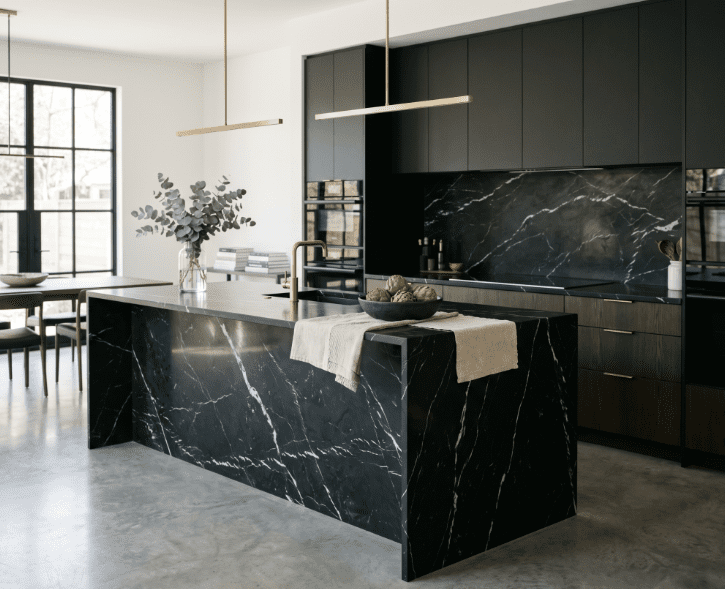
There’s something undeniably commanding about a dark stone countertop. From anchoring a kitchen island to grounding a bathroom vanity, black and near-black surfaces bring a sense of depth and drama that lighter materials simply can’t match. But when it comes to choosing between black marble countertops and other dark stone options, the decision goes well beyond aesthetics.
Each material has its own personality, its own strengths, trade-offs, and maintenance requirements. This guide will walk you through how black marble compares to other popular dark stones so you can choose with confidence.
The Case for Black Marble Countertops
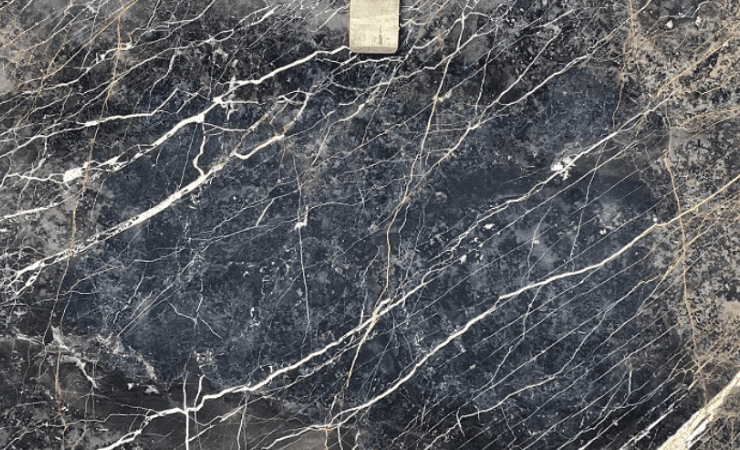
Black marble is one of the most visually striking surfaces available in the natural stone world. Varieties like Nero Marquina feature an intensely dark background threaded with bright white veining, creating a contrast that feels both bold and refined. Others, like Port Laurent, offer richer brown-black tones with more subtle movement, dramatic without being loud.
Beyond its appearance, real marble has a long and storied history as a luxury material. There’s an authenticity to it that’s difficult to manufacture, and in a black marble kitchen, that authenticity reads immediately.
What to Know About Marble’s Performance
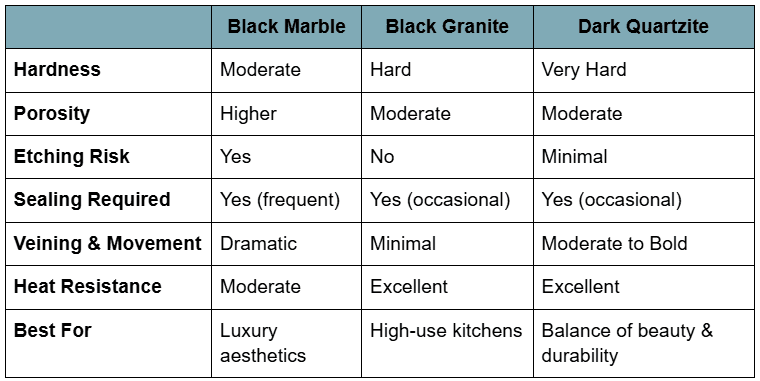
Marble is a metamorphic limestone, and that origin comes with some important performance considerations. It’s softer than granite or quartzite, which makes it more susceptible to scratching over time. More significantly, marble is naturally porous, meaning it can absorb liquids and stain if spills aren’t addressed promptly. Marble countertop durability depends heavily on proper sealing and consistent care.
Marble is also vulnerable to etching, a chemical reaction that occurs when acidic substances like lemon juice, wine, or vinegar come into contact with the surface. On lighter marble, etching is often visible as dull spots. On black marble, the effect can be equally pronounced, leaving lighter marks that disrupt the stone’s deep, polished finish.
This doesn’t make black marble a poor choice, many homeowners embrace the natural patina that develops over time as part of the stone’s character. But it does mean that black marble countertops reward owners who are willing to commit to thoughtful care.
Black marble works best for: Homeowners who prioritize aesthetics and timeless luxury, are comfortable with periodic sealing and careful maintenance, and appreciate the idea of a surface that develops character with age.
Black Granite: The Low-Maintenance Dark Stone
For those who love the idea of a dark stone countertop but want something more forgiving in daily use, black granite is a compelling alternative. Granite is an igneous rock, formed from cooled magma, and it’s significantly harder and denser than marble. This translates directly into better scratch resistance and a surface that holds up well to the rigors of a busy kitchen.
Black granite also carries less porosity than marble, though it still benefits from periodic sealing every one to three years. Crucially, it doesn’t etch. Acidic spills that would damage marble simply don’t have the same effect on granite, which makes it a more confident choice for kitchen countertops where cooking is frequent and spills are inevitable.
Aesthetically, black granite tends toward a more uniform appearance than marble. The deep black background often features flecks of silver, gold, or white minerals rather than the dramatic veining characteristic of black marble. The result is sophisticated and polished, but less visually dynamic for those drawn to bold stone movement.
Black granite works best for: Homeowners who want dark countertops with minimal maintenance demands and strong durability, particularly in high-use kitchens.
Dark Quartzite: Beauty with Added Resilience
Dark quartzite occupies a fascinating middle ground in the world of black and charcoal countertops. While quartzite doesn’t typically reach the true black tones of Nero Marquina marble or absolute black granite, deep gray and charcoal varieties can deliver a similarly dramatic effect with a distinctly natural, layered aesthetic.
What sets quartzite apart is its hardness. Ranking around 7 on the Mohs scale, harder than both marble and many granites, quartzite offers exceptional scratch and heat resistance. It also resists etching far better than marble, making it a strong performer in kitchens where acidic ingredients are a regular presence.
Like marble and granite, quartzite is a natural stone and requires sealing. But its inherent toughness means the stakes of everyday use are lower. Dark quartzite countertops bring the organic, one-of-a-kind quality of natural stone with performance that more closely rivals engineered surfaces.
Dark quartzite works best for: Homeowners who want natural stone character and design flexibility, combined with durability that can handle the demands of an active kitchen or bathroom.
Side-by-Side: How the Dark Stones Compare
Design Ideas for Dark Stone Countertops
Regardless of which material you choose, dark stone countertops open up a world of striking design possibilities. Here are a few directions worth considering:
Contrast with Light Cabinetry: White or cream cabinetry paired with a black marble countertop kitchen creates one of the most timeless combinations in contemporary design. The dark stone grounds the space while the light cabinets keep it feeling open and fresh. For black and white marble countertop inspiration, the contrast speaks for itself.
Tone-on-Tone Drama: For a bolder approach, pair dark stone with deep-toned cabinetry in navy, forest green, or charcoal. This creates a moody, enveloping aesthetic that feels intentional and sophisticated.
Warm Metal Accents: Brushed gold or unlacquered brass hardware softens the intensity of black stone countertops beautifully, adding warmth and preventing the space from feeling cold.
Modern Black Marble Countertop Kitchens: Modern black marble countertops pair particularly well with minimalist design, flat-front cabinetry, integrated appliances, and clean sightlines that let the stone’s natural drama take center stage.
Making the Right Choice for Your Home
All three of these dark stones are beautiful, and any one of them could be the right choice depending on your priorities. If maximum visual impact and timeless luxury are your primary goals and you’re prepared to give your countertops the care they deserve, black marble countertops deliver an unmatched result. If you cook frequently and want a surface that handles real-world demands with minimal fuss, black granite or dark quartzite will serve you better.
The best way to make this decision is to see the options in person, to run your hand across a polished slab and see how the light plays across it in different conditions.
Explore Dark Stone at UMI Stone
At UMI Stone, we carry a carefully curated selection of premium dark stone surfaces, including black marble, granite, and quartzite in a range of colors and finishes. Our team is here to help you understand the differences and find the surface that’s right for your space. Visit a showroom near you or contact us today to start exploring your options.

