

If you’ve been shopping for countertops, you’ve probably noticed that quartz comes up constantly. It’s durable, low maintenance, and available in an almost endless range of colors and patterns. But one question tends to stop homeowners mid-research: is quartz man made?
The honest answer is: both. Quartz countertops are engineered surfaces, but they’re made primarily from natural quartz mineral. Understanding that distinction matters because it shapes how quartz performs, how it looks, and how it compares to fully natural stones like granite and marble. Here’s what you need to know.
What Is Quartz Countertop Material, Really?
Quartz is one of the most abundant minerals on Earth, and in its natural form it’s exceptionally hard and durable. What we call quartz countertops are actually engineered quartz stone countertops, meaning the material is manufactured rather than cut directly from a quarry slab.
The composition of engineered quartz typically breaks down like this: roughly 90 to 95 percent ground natural quartz crystals, bound together with 5 to 10 percent polymer resins and pigments. The mixture is compressed under intense pressure, then cured at high temperatures to produce a dense, uniform slab.
So when someone asks what quartz counters are made of, the answer is mostly nature with a carefully controlled manufacturing process layered on top. That process is exactly what gives quartz its most practical advantages.
Is Quartz a Natural Stone?
Technically, no. Quartz is not a natural stone in the way that granite, marble, or quartzite are. Those materials are quarried directly from the earth and cut into slabs with minimal processing. Engineered quartz, by contrast, is manufactured in a controlled facility using natural quartz as the primary raw material.
This distinction is worth understanding but shouldn’t be treated as a drawback. The engineering process isn’t about cutting corners, it’s about improving on what nature provides. By binding quartz particles with resin under pressure, manufacturers create a surface that’s more consistent, more durable in certain respects, and significantly easier to maintain than most natural stones.
If you’re asking whether quartz is real stone, it depends on how you define the term. The quartz mineral itself is completely real and natural. The slab format is engineered. Most homeowners, once they understand this, find it adds to quartz’s appeal rather than diminishing it.
How Engineered Quartz Differs from Natural Stone
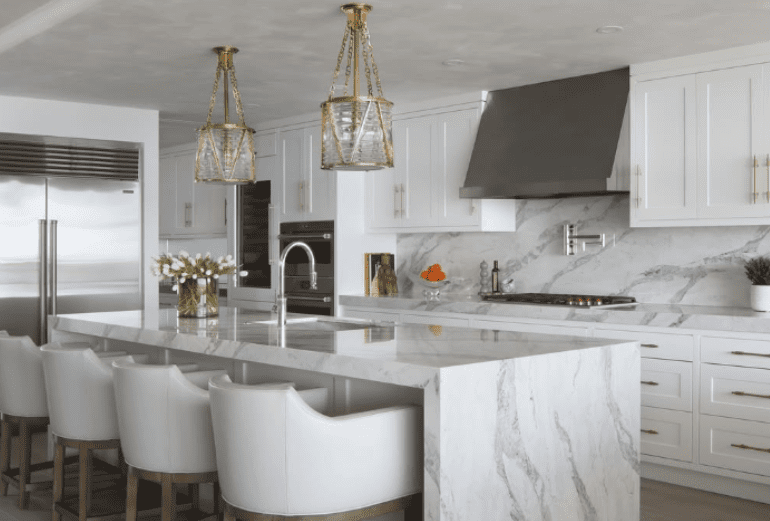
The gap between engineered quartz and natural stone comes down to a few key characteristics.
Consistency
Natural stones like granite and marble vary from slab to slab. The veining, color distribution, and patterning are determined by geological processes that can’t be controlled. Engineered quartz offers a level of visual consistency that’s simply not possible with quarried stone; what you see in the showroom is reliably what you’ll get at home.
Porosity
Natural stones are porous to varying degrees and require periodic sealing to resist staining. Engineered quartz is non-porous. The resin fills every gap between quartz particles, creating a surface that doesn’t absorb liquids, bacteria, or stains. No sealing is ever required.
Hardness and Durability
Natural quartz mineral ranks 7 on the Mohs hardness scale, making it harder than most natural stone surfaces used for countertops. The durability of quartz countertops reflects that underlying hardness, offering strong resistance to scratching and chipping in everyday kitchen use.
Heat Sensitivity
This is one area where natural stone has an edge. The polymer resin in engineered quartz can be affected by prolonged heat exposure, which is why trivets are recommended under hot pots and pans. Granite and quartzite handle heat more naturally.
Man Made Quartz vs. Natural Quartz: What About Quartzite?
One of the most common points of confusion in the countertop world is the difference between quartz and quartzite. They sound similar and are often confused, but they’re fundamentally different materials.
Quartzite is a natural metamorphic stone. It begins as sandstone and transforms under heat and pressure deep within the Earth, producing a hard, dense surface that’s quarried and cut just like granite or marble. It’s completely natural, requires sealing, and has its own distinct aesthetic with natural variation in color and veining.
Engineered quartz, by contrast, is manufactured. The two share the same mineral as a base ingredient, but the similarity largely ends there. When comparing man made quartz vs. natural quartz (or quartzite), the choice comes down to whether you prioritize the authenticity and organic character of a quarried stone or the consistency and low maintenance of an engineered surface.
The Benefits of Choosing Engineered Quartz
For homeowners weighing their options, engineered quartz brings a compelling set of practical advantages.
- Low Maintenance: No sealing, no special cleaners, no periodic treatments. Soap and warm water handle the vast majority of everyday messes.
- Design Flexibility: Because the appearance of engineered quartz is controlled during manufacturing, it’s available in a wider range of colors and patterns than any single natural stone. Realistic marble looks, bold solid colors, and subtle neutral tones are all achievable.
- Hygienic Surface: The non-porous structure means bacteria and mold have nowhere to hide, making quartz a particularly strong choice for food preparation areas.
- Consistent Quality: Every square inch of a quartz slab offers the same level of performance, with no weak spots or natural variations in density that could create vulnerabilities.
For kitchen island quartz tops specifically, the combination of durability and design range makes engineered quartz one of the most versatile choices available.
Quartz in Kitchen and Bathroom Design
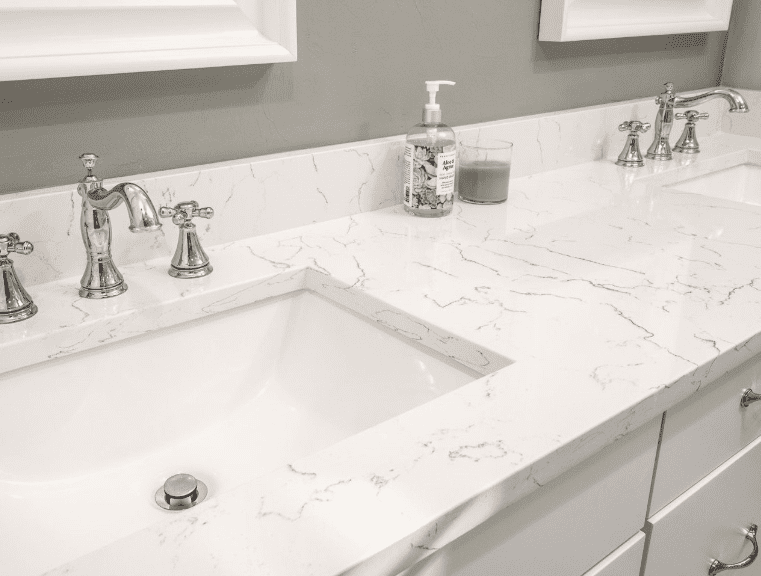
Engineered quartz fits comfortably into virtually any design direction, which is part of why it’s become so dominant in both kitchens and bathrooms.
In kitchens, quartz performs particularly well on high-use perimeter countertops where stain resistance and easy cleaning matter most. Its consistency makes it a reliable choice for large installations where matching slabs is important. For quartz countertop thickness considerations, 3 cm is the standard for most kitchen applications and delivers the visual weight and structural integrity that high-use surfaces demand.
In bathrooms, quartz’s non-porous nature is a meaningful advantage in a moisture-rich environment. It resists the humidity and occasional water exposure that can challenge natural stones over time, and its range of finishes and colors means it adapts gracefully to everything from spa-inspired neutrals to bold, dramatic vanity statements.
Is Quartz the Right Choice for Your Home?
Engineered quartz countertops are an excellent fit for homeowners who want a surface that performs reliably, requires minimal upkeep, and offers genuine design flexibility. If you cook frequently, have a busy household, or simply prefer not to think much about countertop maintenance, quartz delivers on all of those fronts.
If you’re drawn to the authenticity of a material with a geological story — the one-of-a-kind character of a slab pulled from a specific quarry — natural stone may ultimately be more satisfying. But for most homeowners balancing beauty and practicality, engineered quartz is one of the strongest options on the market.
Explore Quartz at UMI Stone
At UMI Stone, we carry a carefully curated selection of premium engineered quartz in a wide range of colors, patterns, and finishes. Whether you’re drawn to the clean simplicity of a solid surface or the dramatic movement of a marble-inspired design, our team can help you find the right fit for your space. Visit a showroom near you or contact us today to get started.
Frequently Asked Questions
Is quartz man-made or natural?
Quartz countertops are engineered surfaces made primarily from natural quartz mineral. About 90 to 95 percent of the material is ground natural quartz, bound together with polymer resins and pigments. So while the manufacturing process is man-made, the core ingredient is completely natural.
Is quartz considered a natural stone?
Not in the traditional sense. Natural stones like granite, marble, and quartzite are quarried directly from the earth and cut into slabs. Quartz countertops are manufactured in a controlled facility, which is why they’re referred to as engineered stone rather than natural stone.
Is engineered stone the same as quartz?
Yes, engineered stone and quartz are used interchangeably in the countertop industry. Both terms refer to the same manufactured surface made from ground quartz crystals bound with resin.
Are quartz countertops natural stone?
No, but they contain natural stone as their primary ingredient. The distinction is in the manufacturing process. Quartz countertops are engineered rather than quarried, which is what gives them their consistency and non-porous surface.
What is a quartz countertop made of?
Quartz countertops are made of roughly 90 to 95 percent ground natural quartz crystals combined with polymer resins and pigments. The mixture is compressed under high pressure and cured at elevated temperatures to produce a dense, durable slab.
What is the difference between quartz and quartzite?
Quartz is an engineered surface manufactured from ground quartz mineral and resin. Quartzite is a fully natural metamorphic stone quarried directly from the earth. Both are durable, but quartzite requires sealing while engineered quartz does not.
Do quartz countertops require sealing?
No. Because engineered quartz is non-porous, it never requires sealing. The resin used in manufacturing fills every gap between quartz particles, preventing liquids, bacteria, and stains from penetrating the surface.

