
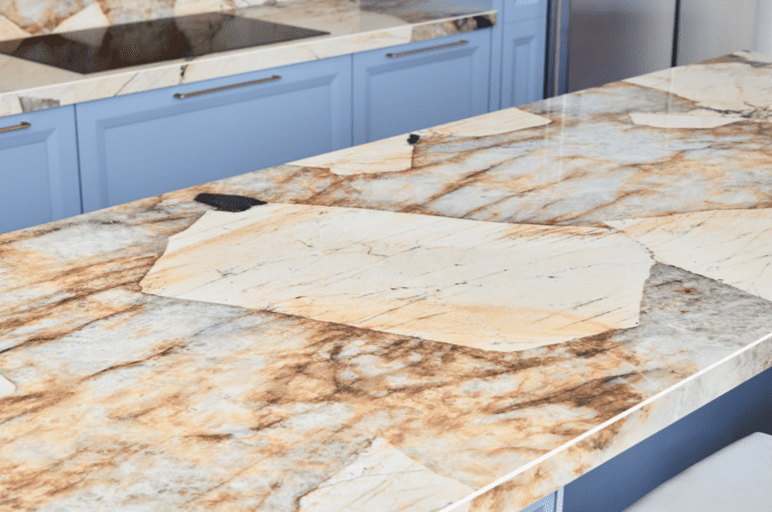
When homeowners start shopping for granite countertops, thickness isn’t always the first thing that comes to mind. Color, pattern, and finish tend to get most of the attention. But thickness is one of those details that quietly shapes everything: how durable the surface is, how it looks in the finished space, and how well it holds up over years of daily use.
So, how thick are granite countertops? The answer is more nuanced than a single number, and understanding your options will help you make a more confident decision for your kitchen or bathroom.
Standard Granite Countertop Thickness Options
Granite countertops are most commonly available in two standard thicknesses: 2 centimeters (roughly 3/4 inch) and 3 centimeters (roughly 1-1/4 inches). These measurements refer to the thickness of the slab itself before any edge treatments or fabrication work is applied.
2 cm Granite
2 cm granite was the industry standard for many years and remains a common option, particularly for certain applications and price-conscious projects. It’s lighter than thicker slabs, which can make handling and installation easier, and it typically comes at a lower cost.
That said, 2 cm granite has some practical limitations. Because it’s thinner, it requires a plywood substrate beneath the surface for structural support. Without that backing, the slab is more vulnerable to cracking under pressure or impact. For kitchen countertops that see heavy daily use, the additional support requirement is worth factoring into your planning.
3 cm Granite
3 cm granite has become the preferred standard for most residential kitchen countertops, and for good reason. The added thickness gives the slab significantly more structural integrity, allowing it to span cabinetry without requiring a plywood underlayment in most cases. It also has a more substantial, premium appearance. The edge of a 3 cm slab has a visual weight that reads as high-quality and well-crafted.
For most homeowners choosing granite countertops for a kitchen, 3 cm is the right starting point. It’s more durable, easier to work with during fabrication, and delivers a finished look that holds up to scrutiny from every angle.
How Thickness Affects Durability
Thickness and durability are directly related in natural stone. A thicker slab simply has more material to absorb stress, resist impact, and maintain its structural integrity over time. This matters most in kitchens, where countertops regularly bear the weight of appliances, cutting boards, pots, and everyday use.
Thinner 2 cm slabs, when properly supported, can perform well, but the margin for error is smaller. An unsupported span, a heavy impact, or improper installation can result in cracking that would be far less likely with a 3 cm slab. For granite bathroom countertops, where spans tend to be shorter and loads lighter, 2 cm can be a perfectly practical choice.
When choosing granite countertops for any high-use area, prioritizing thickness is one of the simplest ways to protect your investment.
How Thickness Influences the Look
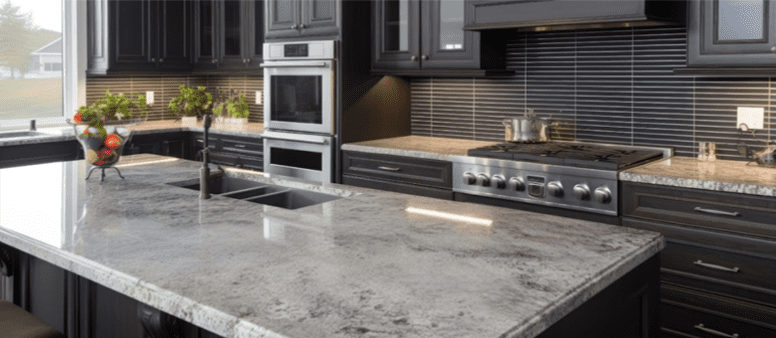
Beyond performance, thickness plays a meaningful role in the visual character of a finished countertop. This is where fabrication choices come into play.
Edge Profiles
The edge of a countertop is where thickness becomes most visible. A 3 cm slab with a simple eased edge projects a clean, modern confidence. The same slab with an ogee or bullnose profile takes on a more traditional, decorative character. Thicker slabs give fabricators more material to work with, opening up a wider range of edge profile options.
For homeowners who want the look of an even thicker countertop, a particularly dramatic and weighty edge that commands attention, fabricators can laminate two pieces of granite together at the edge to create the appearance of a 6 cm slab. This technique delivers serious visual impact without the structural and cost implications of a genuinely thicker stone.
Waterfall Edges
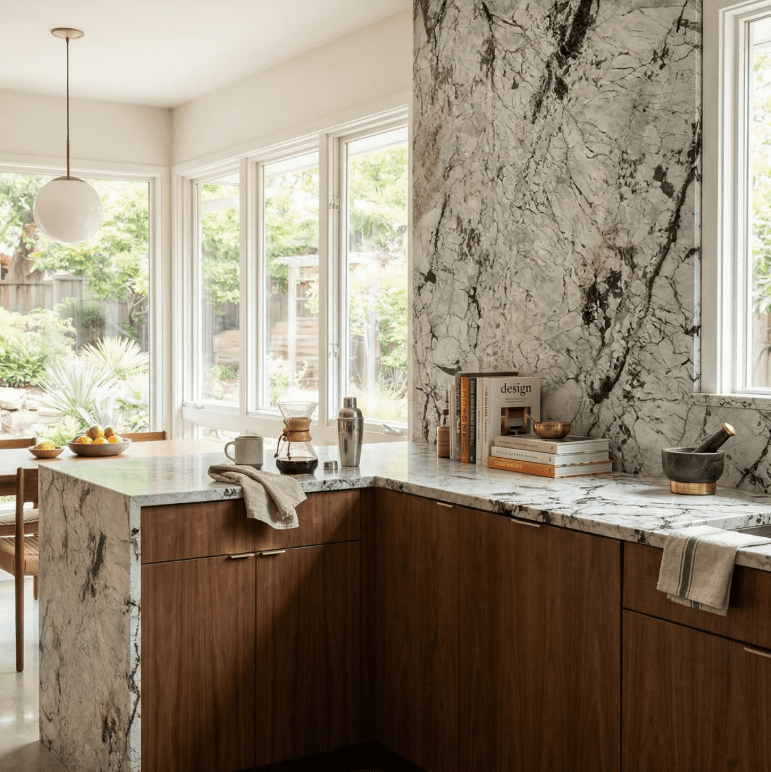
A waterfall edge, where the countertop material continues vertically down the side of an island to the floor, is one of the most striking applications in contemporary kitchen design. For this look, slab thickness matters both structurally and aesthetically. A 3 cm slab carries the visual weight needed to make a waterfall edge feel intentional and substantial rather than thin and fragile.
Matching Thickness to Kitchen Style
How thick granite kitchen countertops should be often comes down to the overall design direction of the space.
In modern and contemporary kitchens, thinner profiles or clean 3 cm edges with minimal detailing reinforce the sleek, uncluttered aesthetic. The stone’s natural color and pattern do the heavy lifting visually, and the edge stays out of the way. For granite countertop color choices in these spaces, cleaner, more uniform stones tend to complement the streamlined look.
In traditional kitchens, thicker edges with decorative profiles like ogee, dupont, or rope edges feel appropriate and well-considered. The added visual weight of a 3 cm slab with a sculpted edge reinforces the room’s sense of craftsmanship and permanence.
For lighter, brighter kitchens, white granite countertops in a 3 cm thickness with a simple polished edge strike an ideal balance between substance and airiness.
What to Ask Your Fabricator
When you’re working through the details of a granite countertop project, thickness should be part of the early conversation with your fabricator. Here are a few practical questions worth raising:
- Does the cabinet configuration require a plywood substrate for a 2 cm slab, and what does that add to the overall cost?
- What edge profiles are available for the thickness you’re considering?
- Are there spans in the layout (over dishwashers, for example) where additional support is recommended regardless of thickness?
- What does the fabricator recommend for your specific stone, since some granite varieties are naturally denser and more flexible than others?
Getting clear answers to these questions early will prevent surprises during installation and help you make a choice that performs as well as it looks.
Explore Granite at UMI Stone
Now that you have a clearer picture of how thick standard granite countertops are and what those differences mean in practice, the next step is finding the right stone for your project. At UMI Stone, we carry a curated selection of premium granite in a wide range of colors, patterns, and finishes. Our team can help you navigate thickness options, edge profiles, and everything else that goes into a countertop you’ll be proud of for decades. Visit a showroom near you or contact us today to get started.
Frequently Asked Questions
How thick are standard granite countertops?
Most granite countertops are either 2 cm (about 3/4 inch) or 3 cm (about 1-1/4 inches) thick. 3 cm has become the preferred standard for residential kitchens due to its added durability and more substantial appearance.
Is 2 cm granite too thin for a kitchen countertop?
Not necessarily, but it does require a plywood substrate for proper support. For high-use kitchen environments, 3 cm is generally the stronger and more practical choice. 2 cm works well in bathrooms and applications where spans are shorter and loads are lighter.
Does thicker granite cost more?
Yes, 3 cm granite typically costs more than 2 cm due to the additional material. However, the savings on a 2 cm slab can be offset by the cost of the required plywood underlayment, so it’s worth comparing total project costs rather than material price alone.
Can granite countertops be made thicker than 3 cm?
Standard slabs top out at 3 cm, but fabricators can laminate an additional piece of granite along the edge to create the appearance of a 6 cm slab. This is a popular technique for achieving a bold, weighty edge profile without sourcing an unusually thick slab.
Does granite thickness affect the edge profile options available?
Yes. Thicker slabs give fabricators more material to work with, which expands the range of edge profiles available to you. Decorative profiles like ogee, dupont, and waterfall edges are best suited to 3 cm slabs.
What thickness is best for a granite bathroom countertop?
2 cm granite can work well in bathrooms where spans are shorter and heavy loads are less common. That said, many homeowners opt for 3 cm throughout the home for consistency and peace of mind.

