
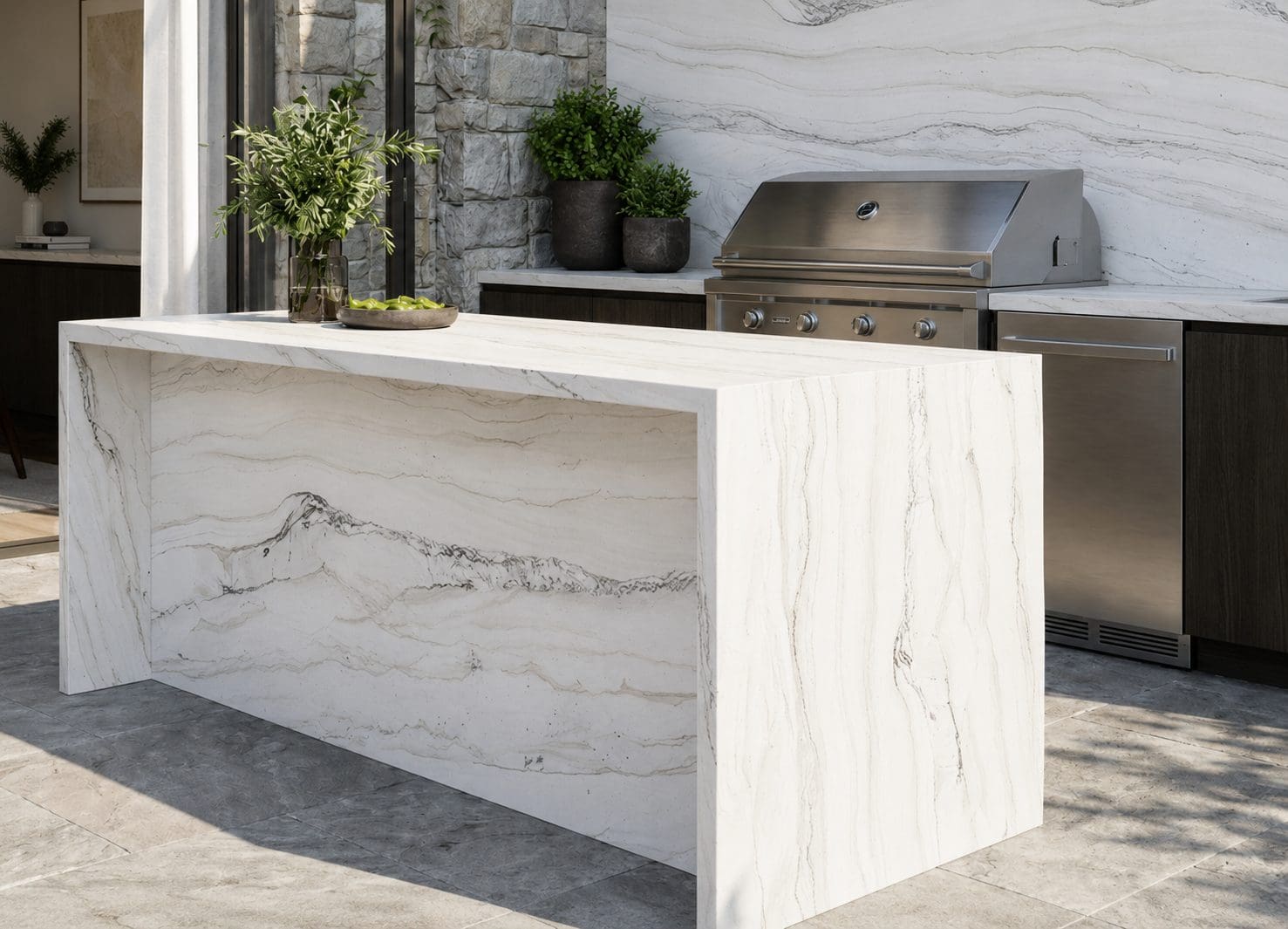
Outdoor kitchens have moved well past the basic grill-and-a-side-burner setup that defined them a decade ago. Today’s outdoor cooking and entertaining spaces are designed with the same intentionality as interior kitchens, which means the countertop question has gotten more serious. Homeowners and designers are looking for materials that can handle the outdoors without compromising on aesthetics, and that search keeps leading back to quartzite.
So can quartzite be used outside? Yes, and for good reason. Here’s why it’s become one of the most compelling natural stone options for outdoor kitchen countertops, along with what you should understand before making the call.
What Makes Quartzite Well-Suited for Outdoor Use
Quartzite isn’t just a beautiful stone, it’s one that earned its hardness under some of the most extreme geological conditions on Earth. Formed when sandstone is subjected to intense heat and pressure deep within the Earth’s crust, quartzite emerges as a metamorphic rock with a density and structural integrity that most natural stones can’t match.
That origin matters for outdoor applications in very practical ways.
Hardness
Quartzite ranks around 7 on the Mohs hardness scale, making it harder than granite and significantly harder than marble. That hardness translates directly into resistance to scratching, chipping, and surface wear from outdoor elements, cookware, and daily use.
Heat Tolerance
A stone formed under extreme geological heat handles the thermal demands of an outdoor kitchen with ease. Hot cookware, direct sun exposure, and the residual heat of a grill nearby all fall well within what quartzite can manage without surface damage.
UV Resistance
Quartzite is a fully natural stone with no synthetic components, which means UV exposure doesn’t degrade or discolor it the way it can with engineered materials. Its color stability outdoors is one of its strongest arguments for the application.
Density and Low Porosity
Compared to other natural stones like marble or limestone, quartzite is notably dense and relatively low in porosity. That density makes it more resistant to moisture infiltration, freeze-thaw cycles, and the kind of slow surface degradation that affects softer, more porous stones over time.
For a deeper look at how quartzite holds up under pressure, the performance characteristics that make it exceptional indoors apply equally, and in some cases more emphatically, outdoors.
Why Quartzite Outperforms Engineered Quartz Outside
This is one of the most important distinctions homeowners researching outdoor countertops need to understand. Engineered quartz is an excellent indoor countertop material, but it is not well-suited for outdoor use, and the reason comes down to its composition.
Engineered quartz contains polymer resins that bind the ground quartz crystals together and give the surface its non-porous quality. Those resins are vulnerable to prolonged UV exposure. Over time, direct sunlight causes the resin to yellow, discolor, and in some cases degrade structurally. A quartz countertop that looks pristine in a showroom or indoor kitchen can look noticeably different after a few seasons in an outdoor environment.
Quartzite has no resins. It’s a fully natural stone, and its color and composition are stable under UV exposure in ways that engineered surfaces simply cannot match. When comparing quartz vs. quartzite for outdoor applications specifically, quartzite wins decisively.
The Honest Caveats
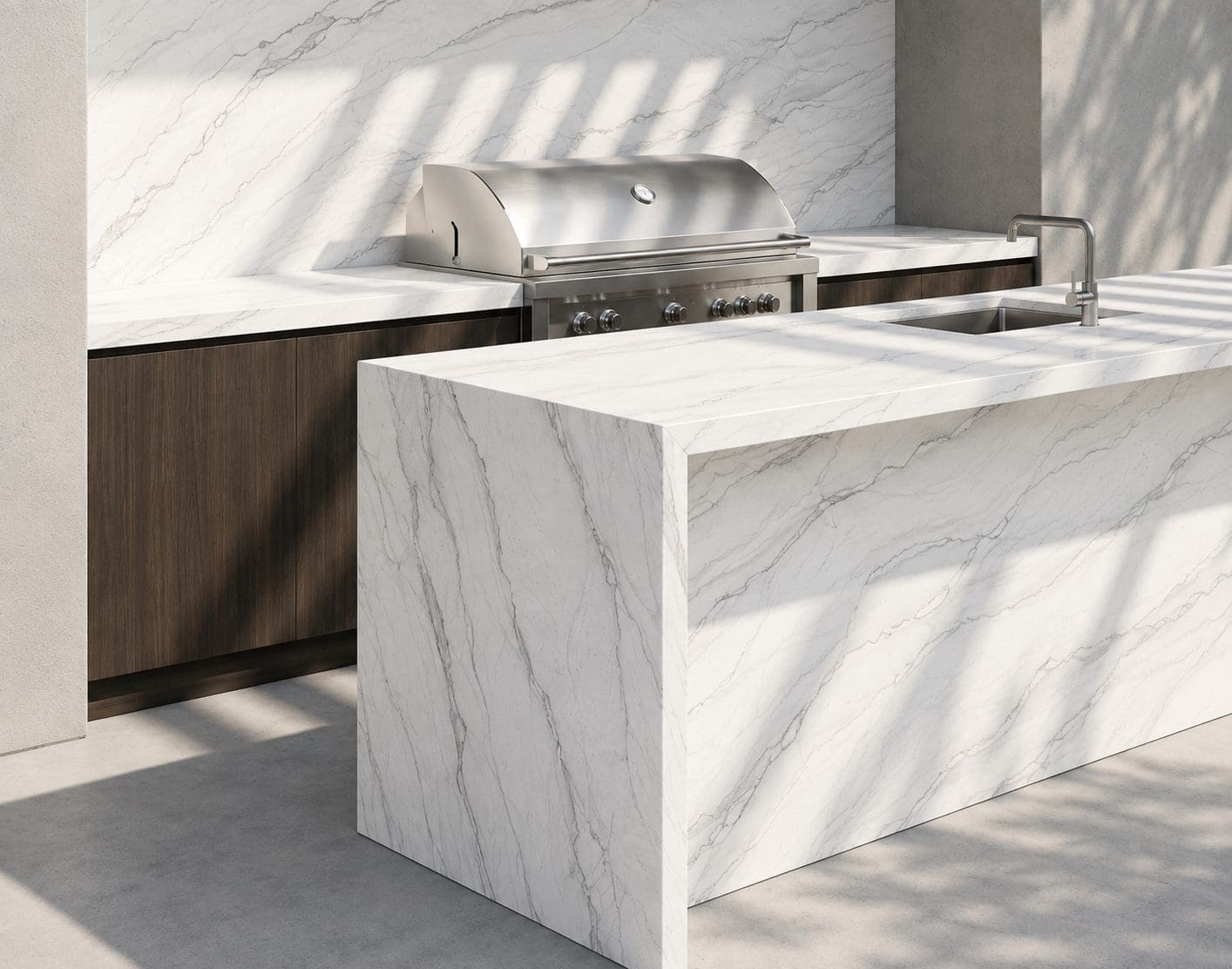
Recommending quartzite for outdoor use doesn’t mean presenting it as maintenance-free or invulnerable. There are real considerations worth understanding before you commit.
Sealing is non-negotiable outdoors. Quartzite requires sealing in indoor applications, and that requirement is more demanding outside. Exposure to rain, humidity, temperature swings, and direct sun accelerates sealant wear. For outdoor quartzite countertops, plan on sealing annually rather than every one to two years as you might indoors. A quality penetrating stone sealer applied consistently is what keeps the surface performing well over time.
Darker slabs in full sun may see some fading. While quartzite is UV-stable compared to engineered materials, darker varieties with intense color saturation can experience some degree of lightening over years of direct sun exposure. This is a gradual, natural process rather than a dramatic change, but it’s worth knowing. Lighter quartzite varieties, whites and creams, are inherently more stable in this respect because there’s less pigment variation to shift.
Covered or shaded placement is ideal. Quartzite for outdoor kitchens performs best and looks best longest when it’s positioned under a pergola, covered patio, or some form of overhead protection. Full, unobstructed sun exposure year-round puts more stress on any countertop surface than a shaded installation does. A covered outdoor kitchen with quartzite countertops gets the best of both worlds: the durability and beauty of the stone with meaningfully reduced environmental stress.
The Design Case for Quartzite Outdoor Countertops
Beyond performance, quartzite outdoor countertops make a strong design argument. The material occupies a unique aesthetic position: it delivers the marble-like elegance and natural veining that makes a space feel intentionally designed, with the hardness and durability of granite. For outdoor kitchens that are meant to feel like genuine extensions of a home’s interior rather than afterthoughts, that combination is hard to replicate.
Each quartzite slab is unique, which means no two outdoor kitchen installations look alike. The natural variation in veining, color depth, and movement gives the space a one-of-a-kind quality that no manufactured surface can offer. Explore the full range of quartzite countertop slabs to understand how much variety exists within this single material category.
For outdoor kitchen countertop planning more broadly, quartzite fits comfortably alongside stainless steel appliances, teak or ipe wood accents, concrete, and natural tile, making it one of the more versatile material partners in an outdoor build.
Quartzite Varieties That Work Well Outdoors
When selecting a quartzite for an outdoor application, lighter varieties with lower porosity and stable, light-toned backgrounds tend to perform most consistently over time.
Taj Mahal is among the most popular quartzite options for outdoor kitchens. Its warm, creamy white background with soft gold veining reads beautifully in natural light, and its relatively dense composition makes it a reliable outdoor performer. It also brings a refined, almost luminous quality to outdoor spaces that elevates the entire kitchen environment.
Mont Blanc offers a brighter white background with subtle, delicate veining that creates a clean, contemporary aesthetic outdoors. Its lighter tones make it less susceptible to visible UV-related fading and give it a fresh, open quality that works well in both covered and partially exposed outdoor settings.
White Macaubas delivers a crisp, cooler white base with silver-grey veining that photographs beautifully and holds up well in outdoor environments. Its more neutral character makes it a strong design partner for a wide range of outdoor materials and finishes.
For the current selection of these and other quartzite varieties, visit UMI Stone’s quartzite collection or speak with our team about what’s available in your region.
A Material That Earns Its Place Outside
Quartzite outdoor countertops have gained attention because they genuinely deserve it. The material brings together the geological hardness and UV stability that outdoor applications demand, the natural beauty that elevates a well-designed outdoor kitchen, and a performance profile that outpaces both natural marble and engineered quartz in this specific context.
The investment in a quality quartzite slab, properly sealed and thoughtfully installed, pays off in a surface that handles real outdoor conditions without losing its character. That’s a standard that few countertop materials can meet, and it’s why the most popular quartzite varieties keep showing up in outdoor kitchen projects alongside their indoor applications.
Explore Quartzite at UMI Stone
At UMI Stone, we carry a curated selection of premium quartzite slabs suited to both indoor and outdoor applications. Our team can help you identify the right variety for your outdoor kitchen, understand the sealing and maintenance requirements, and find a slab that delivers the beauty and performance your project deserves.
Visit a showroom near you or contact us today to start planning.

